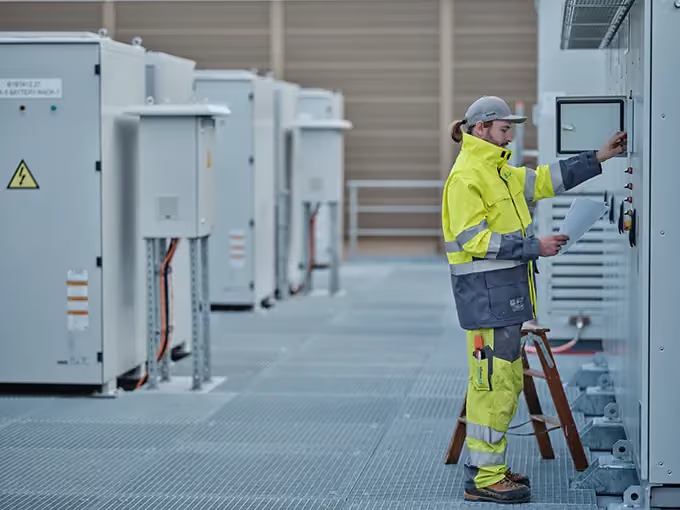
Starting with this issue, we’ll be taking you behind the scenes of uptownBasel’s energy infrastructure — in no particular order, over the coming months. The focus will always be on our new battery energy storage system (BESS), or ‘battery storage’ for short: what it is, what it means for tenants — and which other topics are directly or indirectly related to it, which we will also be exploring in this series.
Battery storage in the interconnected grid: balancing power for Swissgrid
At first glance, a battery storage system seems straightforward: it stores electricity, holds it temporarily, and then feeds it back into the grid. In reality, however, batteries are much more sophisticated today, particularly when they are intelligently integrated into the electricity grid. At uptownBasel, we can connect the battery to the national grid to provide balancing power. This involves committing to make a certain capacity available, which Swissgrid can then access at any time — a process that is fully automatic and does not require human intervention.
Peak shaving: Reducing peak demand, cutting costs
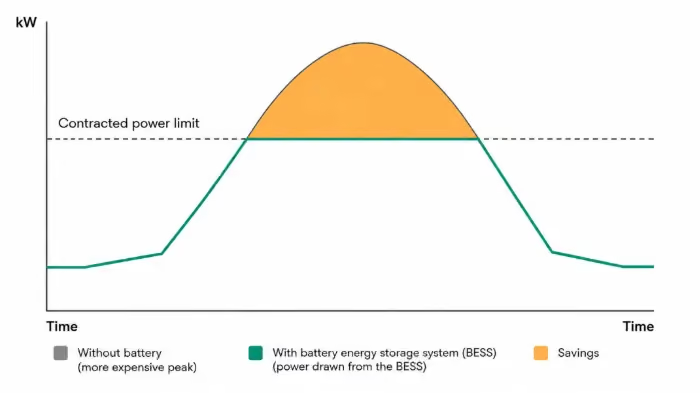
The BESS adds value not only to the wider electricity grid, but also to the campus itself. For us on campus, this is particularly evident where electricity consumption is inconsistent. Those who operate machinery, such as an AI factory, will be familiar with the problem of peak loads, which can significantly impact grid costs. Peak shaving addresses this issue by providing additional energy when demand is high, thereby reducing the amount drawn from the electricity grid. The peak load is 'shaved off', which takes the strain off the grid infrastructure and can reduce power-dependent grid costs.
Planned safely, operated safely.
Safety is a key component of the system design. The BESS features several coordinated levels of protection. In the event of a mains power failure, for example, a separate power supply supports key functions, while sensors detect critical deviations at an early stage and trigger automatic protective mechanisms where necessary. Additional safety devices are also integrated directly into the battery cabinets. These technical measures are complemented by a comprehensive safety and operational concept. The system also uses lithium iron phosphate (LFP) batteries, which are characterised by high thermal stability.
Guaranteed grid capacity thanks to our own substation
While BESS ensures flexibility, the site’s own substation provides the necessary connected load. With up to 40 MVA, uptownBasel has high-capacity grid access, which is a crucial advantage for tenants with high electricity requirements. This means the campus is equipped to handle energy-intensive applications while simultaneously laying the infrastructural foundations for further growth.
„ We have a secure grid connection with a connection capacity of up to 40 MVA“ — Yves Imoberdorf, CEO uptown batterytogrid
Lower electricity costs thanks to a ZEV
The BESS is just one component of uptownBasel’s energy infrastructure. The self-consumption community (ZEV) offers tenants the direct benefit of using locally generated solar power on campus, which reduces the amount of electricity purchased from the grid. This allows uptownBasel to offer its tenants more attractive electricity terms.
Battery storage with foresight
The commitment to installing a BESS at the uptown Basel campus is intended to support the site's future development and growth. The current size is based on known demand, such as that from data centres and the AI Factory, and design has been made from the outset for future expansion.
„ We designed our own battery energy storage system to keep pace with the campus's growth. “ — Yves Imoberdorf, CEO uptown batterytogrid
In the next edition of our series, 'Energy that thinks for itself', we will take a closer look at the technology behind the system.
