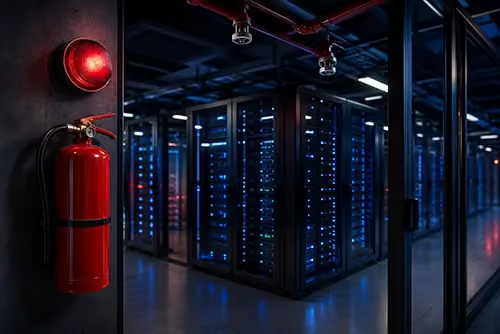
Fire Safety for the PHOENIQS AI Supercomputer
A supercomputer never sleeps. It runs aroundthe clock, generates extreme waste heat, and represents an enormous asset value— conditions that place very different demands on fire safety than aconventional office building. The uptownBasel innovation campus is home to oneof Switzerland's most powerful AI infrastructures: the PHOENIQS AISupercomputer. That such a facility requires a tailor-made fire safety conceptgoes without saying — what that concept looks like, and what makes it special,is explained by Stefan Bühlmann.
Bühlmann is a certified fire safety expert(VKF) and specialist in fire alarm systems, certified under the guidelines ofthe Association of Cantonal Fire Insurers (VKF), the governing standard forfire safety in Switzerland. Through his company, safetyfocus GmbH Brandschutz (Diegten, founded in 2014), he handles a broad range ofprojects — from small buildings to commercial and industrial properties andcomplex mixed-use developments. The scale and pace of the uptownBasel projectled him, among other things, to set up an additional office directly on site,so that someone is always available on the campus when needed. At uptownBasel,Bühlmann is personally responsible for the fire safety concept — for the entiresite, not just the supercomputer.
People first — always
Fire safety law is unambiguous in itspriorities: people must be able to reach safety first, and protection of assetscomes second.
"People must be able to escape — that's a legal requirement" — Stefan Bühlmann, safetyfocus GmbH
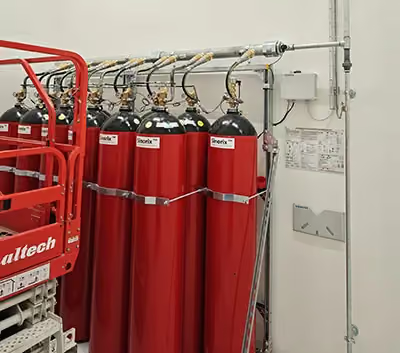
For the PHOENIQS AI Supercomputer, however, itquickly became clear that minimum protection would not be sufficient. The assetvalue of the system is enormous — a fire that ran its course under minimumstatutory requirements would have catastrophic financial consequences. Anenhanced protection concept was therefore developed from the outset: earlydetection, automatic sensing of smoke and heat, and a nitrogen suppressionsystem that displaces oxygen in the event of a fire without leaving anyresidue.
Fire risks: heat, electricity, and cooling
The fire risks of a supercomputer differfundamentally from those of an ordinary building. According to Bühlmann, theyarise less from typical building use and more from high-current loads, powersupplies, continuous load, and plug connections that heat up under load, spark,and can melt their insulation.
Cooling is particularly critical: the basementhouses a large cooling unit that supplies the supercomputer with air cooling.If it fails, the system generates extreme waste heat — temperatures above 100degrees Celsius are possible. At such temperatures, a fire can start evenwithout an open flame. Monitoring of the cooling system therefore runscontinuously — the responsibility of PHOENIQS or a company commissioned bythem. Bühlmann is clear on the distinction: that is operations, not firesafety. His task is to prevent a fire from growing — should one occur at all.
Two-stage early detection and nitrogen suppression
A pipe system runs through the room,continuously drawing in air and testing it for the smallest smoke particles —finely calibrated to detect even minimal concentrations. If it triggers, amessage is sent immediately to the fire department. The suppression systemitself, however, only activates once a second, independent detector also raisesan alarm — either a further pipe-based aspiration system or a conventionalsmoke detector on the ceiling or in the raised floor.
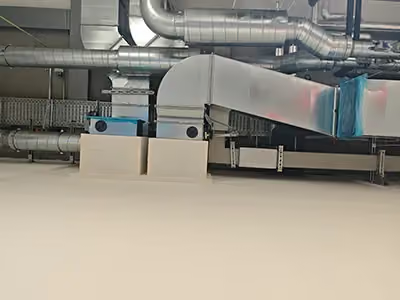
“It always takes two independent triggers to activate the suppression system." — Stefan Bühlmann, safetyfocus GmbH
If one of the fire detectors triggers,ventilation shuts off and doors close automatically. On the second fire alarm,the nitrogen suppression system activates. Cooling deliberately continues torun: it has no connection to the fire and, if anything, has a positive effectby further cooling the room, says Bühlmann.
Fire department access — even at night
One of the central designchallenges is accessibility: the fire department must have access to thesecured rooms at all times — including nights and weekends, without anyone fromthe operator on site. At the same time, the rooms are protected against break-ins.The solution is a key safe, a so-called “shark cylinder,” in which the firedepartment has deposited a master key giving it access to all relevant rooms.
Supercomputer and quantum computer: separate fire compartments
The fire safety concept for the supercomputerand the quantum computer is structurally similar, but the areas are clearlyseparated spatially. Several rooms with 30 minutes of fire resistance liebetween the two systems — in the event of a fire, Bühlmann notes, it would takenearly 90 minutes for a fire to reach the other area. In a real emergency, theentire building is evacuated: protecting people always takes priority.
Maintenance, testing, and continuous monitoring
All components are tested individually on aregular basis, followed by an integrated overall test — triggering detectors,shutting down ventilation, closing doors, activating the suppression system.The most recent such test took place on a Saturday, together with all tradesinvolved: ventilation, electrical, safety officers, and contractors. Suchcomprehensive tests take place at least every four years; fire doors areinspected annually.
Because Bühlmann himself is on site so often,an additional four-eyes principle naturally emerges during ongoing operations.He is always consulted during renovations, to ensure the concept stays up todate.
Mixed use as the biggest challenge
The biggest challenge on the site, according toBühlmann, is mixed use: office space with high occupancy on one side, technicalrooms with little staff but high asset value on the other. Each area requiresan individual, proportionate protection concept — a complexity thatdistinguishes uptownBasel in particular as a campus home to companies from deeptech, medtech, and innovation.
Bühlmann approaches fire safety from atechnical perspective — he is interested in prevention, not firefighting.
“Ideally, a firenever starts in the first place.” Stefan Bühlmann, safetyfocus GmbH
The fact that uptownBasel considers safety from the verybeginning and invests in the infrastructure for it is, in his view, notsomething to take for granted — but rather the foundation that makes suchconcepts achievable at all.
