
Story by QuantumBasel · First published 19 December 2023
VINCI Energies aims to respond to the climate challenge by using innovative solutions to transform its businesses and create environmental value (1). Their teams deploy technologies and integrate customised multi-technical solutions, from design to implementation, operation and maintenance. Through its 1,900 business units, VINCI Energies combines local roots with an agile structure to improve the reliability, efficiency and sustainability of its customers' infrastructure, while striving for global performance that benefits the planet, people and local communities.
The Challenge
During the construction of a building, the design of the heating, ventilation, and air conditioning (HVAC) network involves several steps. One of the final steps in the HVAC design process is called "network generation”. This step ensures that all HVAC elements are correctly connected while meeting safety and sustainability requirements. This step is critical. However, it is also a step that is computationally very expensive or even prohibitive. The challenge is to optimise the design of HVAC duct networks in new buildings by minimising the cost of the duct layout while efficiently delivering the required airflow. The current semi-automated solution used by VINCI Energies is labour-intensive and costly, requiring significant manual work by engineers.
Project Goal
The objective of this project is to reduce the manual effort required to design HVAC networks by developing a more efficient, potentially hybrid quantum-classical solution that minimises costs and delivers short-term business value to VINCI Energies. The proof-of-concept phase aims to create a prototype solution that generates designs that are better than current designs.
This will be measured in terms of:
a) shorter time to solution, b) maximised user comfort and efficiency, c) minimised environmental impact, fuel consumption and emissions, d) reduced costs through shorter HVAC design efforts with fewer connections, as well as reduced manpower and computing power during the generation phase.
Context
- We need to build an HVAC system in a new building
- We need to choose where to build ducts
Goal
Find the lowest-cost network that provides therequired airflow to each room.
Approach
- Choose where to place ducts from alarge set of options
- Choose the size of each duct
NOTE: HVAC network generation was selected as this is a challenging computational bottleneck for VINCI Construction and, at the same time, allows the generation of insights for strategic adjustments
“We believe that today’s quantum technology canplay a key role in ensuring optimal and efficient construction and operation ofbuildings and are eager to use D-Wave’s quantum solutions in support of thateffort” — Dr. Reinhard Schlemmer, Member of the Board, VINCI Energies
Solution Approach
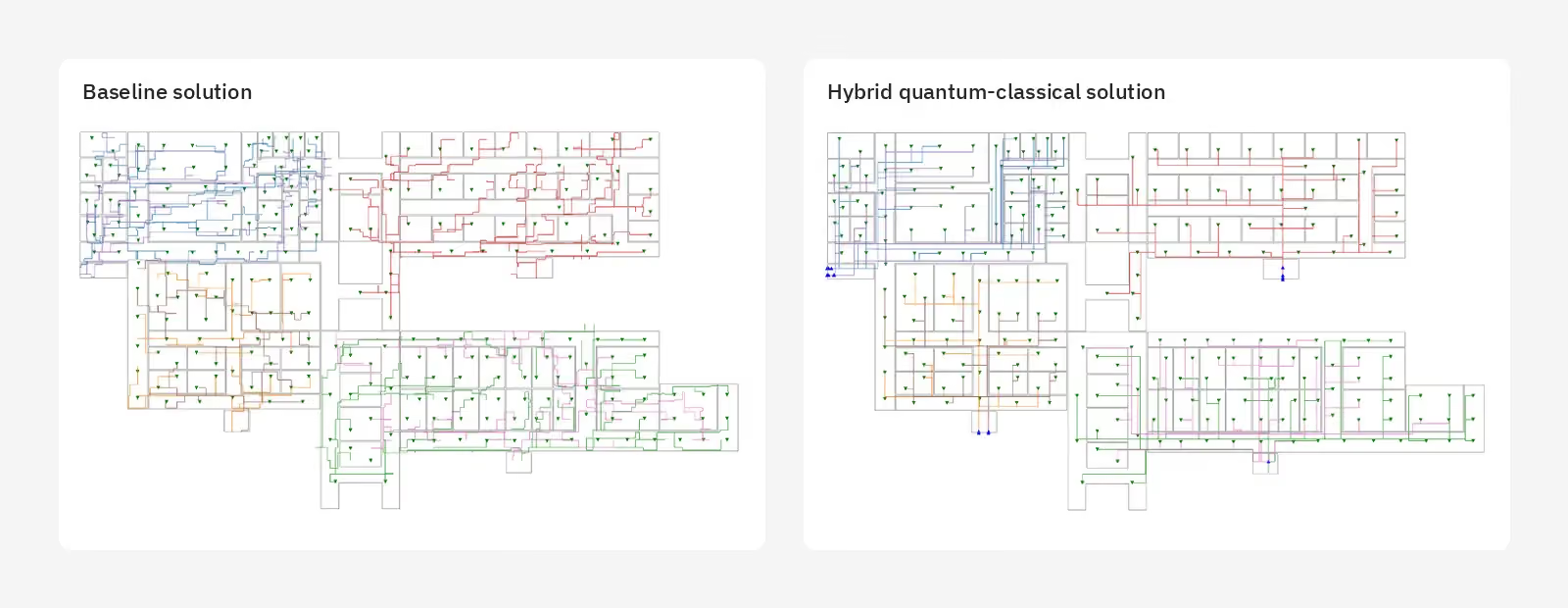
As part of the solution, D-Wave created a hybrid quantum-classical model to solve VINCI Energies' HVAC duct network design problem. QuantumBasel provided VINCI Energies with direct access to D-Wave’s technology and to its network. This approach leveraged quantum computing's ability to address complex combinatorial optimisation challenges by evaluating different configurations of duct placement more efficiently than traditional methods. The project focused on playing to D-Wave's strengths by expressing the model in terms of quadratic forms. Several models were proposed during the project, and the one that best balanced accuracy and cost-effectiveness was selected and implemented. The selected model reduced effort by integrating improved modelling techniques and using both classical and quantum computing resources to reduce manual engineering and optimise design parameters such as duct lengths, diameters, connections, and room crossings. On one representative building plan, the solution outperformed the previous semi-automated method on all performance metrics and achieved a significant reduction in duct length, resulting in significant savings in materials, construction costs, and engineering time, indicating the potential of hybrid quantum-classical computing in real-world engineering applications.
Next Steps
This prototype, developed during the proof-of-concept phase, is intended for further operationalisation. This project also helped VINCI Energies evaluate the feasibility of applying quantum computing to similar optimisation problems. The lessons learned will help VINCI Energies make any necessary adjustments to its broader quantum computing strategy. VINCI Energies will be able to continue to innovate in the optimisation of complex infrastructure designs.
Detail Information
qcPoC Solutions: The qcPoC solutions demonstrate significant improvements, primarily due to their impact on material and construction costs while enhancing aesthetics. By optimising these factors, the solutions achieve a more cost-effective and visually appealing outcome. Additionally, the new approach is noteworthy for its efficiency and scalability - compared to vanilla MIP (Mixed Integer Programs) solvers (CQM formulation) and tools in production. It swiftly identifies solutions, making it a potentially robust choice for larger, more complex projects. However, it's important to note that the performance gains have not yet fully been disentangled, nor has the project focused on enhancing performance with classical Mixed-Integer Programming (MIP) solvers or explored alternative methods. For example, the project did not investigate hybrid acceleration as described in D-Wave's whitepaper "Hybrid Solvers for Quadratic Optimization". This leaves room for further exploration and optimisation in these areas, potentially unlocking even greater efficiencies and improvements in the future.
