
Story by QuantumBasel · First published 18 November 2025
Pfizer Inc. is one of the world’s largestbiopharmaceutical companies, operating a complex global network across R&D,manufacturing, and distribution. Its products span critical therapeutic areaslike oncology, immunology, and vaccines, requiring precise, multi-stageproduction under strict quality and regulatory standards. Efficient schedulingis essential to manage this scale and complexity. To explore next-generationplanning solutions, Pfizer partnered with D-Wave and QuantumBasel to conduct aProof of Technology (PoT) using a hybrid quantum-classical annealing approach.The goal: improve production scheduling at Pfizer’s Freiburg plant compared toexisting and newly optimizedoptimisedclassical methods.
Key Figures
- ≈⅔ makespan reduction in timeframe analyzedanalysed, compared withthe reference solution
- ≈ ⅓ lessfewerconstraint violations
- 100% reduction of critical issues*Nocritical issues observed*
*no machine overlaps, priorityconflicts, or closing time violations observed
The Challenge
Pfizer’s Freiburg site faces significant complexity in its production planning. The plant operates under conditions of high resource utilisation and interdependent, multi-stage manufacturing processes operated in product campaigns. In addition, the schedule needs to be flexible and quickly adaptable to any unforeseen events or changes in the production process.
Last-minute schedule changes require significant manual effort and expertise, making it hard to consistently optimise for delivery, output, and cost. The result is a need for more agile, intelligent scheduling solutions that can reliably handle these dynamic conditions and enhance the utilisation rate of the machines.
Project Goal
In collaboration with QuantumBasel and D-Wave, Pfizer initiated a Proof of Technology (PoT) project to explore advanced methods for job shop scheduling. The primary objective was to evaluate the effectiveness of hybrid quantum-classical annealing methods compared to the current production solution as well as to compare against a newly designed classical high-performance computing (HPC) solution in optimising a six-week production campaign at the Freiburg site. The project aimed to improve critical performance metrics - such as makespan (i.e. the effective duration of the schedule, from first assigned task to completion of the final task), tardiness (number of days beyond deadlines), number of late jobs and constraint violations - while assessing the potential for scalable implementation across Pfizer’s global manufacturing network.
This initiative has brought together local and global stakeholders to test the viability of next-generation computing technologies in a real-world pharmaceutical manufacturing environment.
Methodology
on all jobs and subtasks scheduled within that period. The classical optimisation approach used GPU-based HPC systems and state-of-the-art classical optimisation solvers, while the hybrid quantum method has been performed using D-Wave’s latest hybrid non-linear quantum annealing solver, designed specifically for complex optimisation tasks.
The scheduling model incorporated a variety of operational constraints, including machine availability, job priority, operator scheduling, and adaptation to real-time disturbances. Key Performance Indicators (KPIs) were defined to measure the effectiveness of the model, as presented earlier: total makespan, number of late jobs, average tardiness, and constraint violations. All KPIs were given equal weight in the optimisation process.
Although this first PoT has used a relatively small dataset, it has provided a strong foundation. Future phases are planned to include larger, more complex data sets from additional production sites to test broader scalability and adaptability.
Results
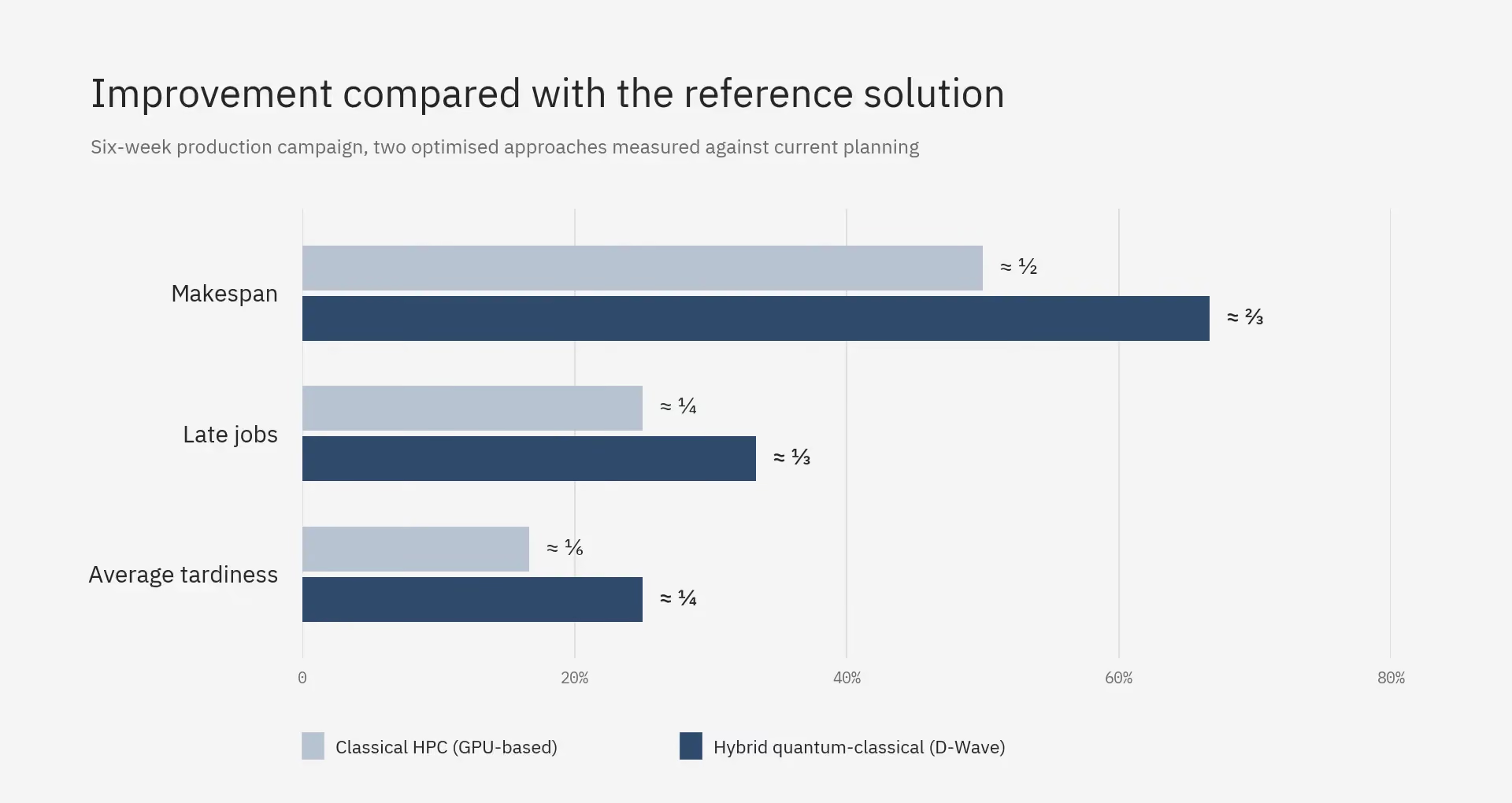
The results have shown clear advantages for both classical and quantum optimisation methods - especially the latter. Total makespan has been reduced by ≈ ⅔ compared to the reference solution, leading to a significant improvement in overall production efficiency. Constraint violations have been reduced by ≈ ⅓ and key problems such as machine overlaps, priority conflicts and closing time violations have been completely eliminated in the analysed period. The number of late jobs and average tardiness have also been significantly reduced.
Comparing classical and hybrid quantum optimisation solutions, the hybrid quantum solution has slightly outperformed the classical HPC model in terms of overall effectiveness. While the classical method has delivered strong results on this dataset, the hybrid quantum solution has been able to deliver slightly better results and may scale better to more complex constraints and larger problems, which future phases are set to test.
This collaboration with QuantumBasel and D-Wave has allowed us to explore the real potential of quantum technologies in a complex, high-stakes production environment. The results we’ve seen at our Freiburg site demonstrate that hybrid quantum approaches can meaningfully enhance scheduling performance and efficiencies, and support a more agile manufacturing process. As we look ahead, we see great promise in further scaling these methods — Pembe Gül Bilir, Project Engineer Innovation, Pfizer Freiburg
- Product makespan was reduced by ≈ ⅔ compared with the reference solution, enabling faster completion of all scheduled jobs.
- Constraint violations dropped by ≈ ⅓, resulting in smoother and more compliant scheduling.
- Critical issues were fully eliminated in the analysed period, with no machine overlaps, priority conflicts, or closing time violations observed.
- There was a significant decrease in late jobs and average tardiness, leading to improved on-time delivery performance.
Business Impact
Optimised schedules have the potential to transform the way Pfizer manages production planning. Faster, more flexible scheduling supports faster ramp-ups, adapts more easily to unforeseen events and changes in the production process and reduces the time required for manual adjustments. By improving resource efficiency, the new schedules could potentially increase overall output and provide significant potential to use machine downtime more effectively—for example, for preventive maintenance. This may lead to cost savings through reduced energy consumption and improved capacity planning. Importantly, the hybrid quantum approach is expected to scale well and to be particularly well suited to larger data sets and more complex manufacturing scenarios. To gain further insights into the method’s global business impact, the next step would be to test it on larger datasets.
The best performance within the PoT was achieved with the quantum optimised solution, followed by the classical optimisation approach. With increasing complexity and data set, an even greater advantage of quantum over classical is expected.
Next steps
Following the success of this initial PoT,Pfizer plans to expand the study to larger datasets and further refine themodels. This effort will include expanded testing, integration with Pfizer’sexisting systems, and an evaluation of the long-term business impact inadditional manufacturing environments.
Read more under https://healthcarehub.pfizer.de/quantum-annealing-proof-technology-pfizer-freiburg-explores-new-methods-production-planning
